Learner stories · From classroom moments to insight

Every learner has a story.

Explore four short classroom stories to see how the right questions, teaching decisions and support can make learning more visible.

Sofia
Sofia

Sofia sees fractions in a new way.

One incorrect answer does not explain what the learner understands. Her teacher Anna investigates the reasoning behind it.

The challenge

Sofia writes ½ + ¼ = ²⁄₆.

The evidence

With fraction strips and prompting, Sofia can show that ½ = ²⁄₄, but does not yet connect this securely to symbolic notation.

Teacher response

Anna models equivalent fractions and asks Sofia to link visual representations to the matching symbols.

Next evidence

Recheck her independent explanation, retention and use of the idea in unfamiliar problems.
Malik
Malik

Malik finds the missing connection.

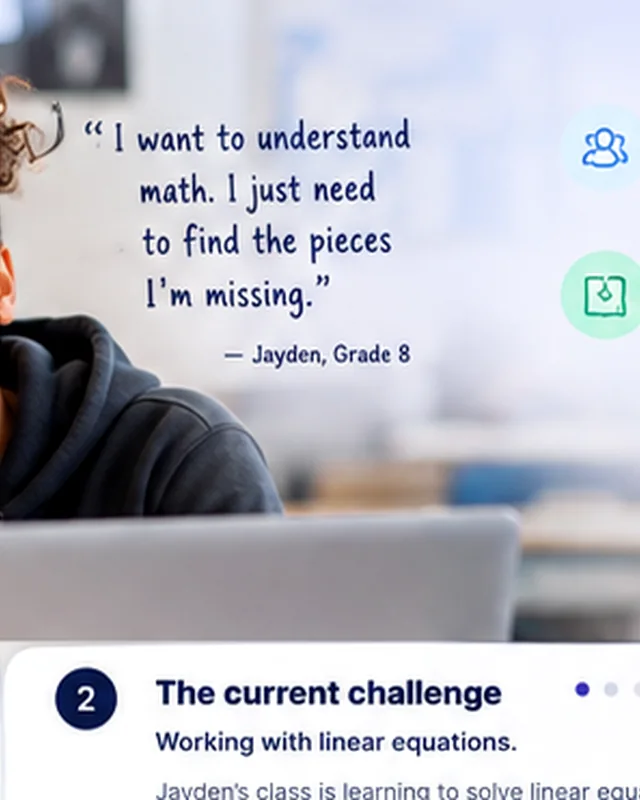
A complex Grade 8 equation becomes easier to investigate when teaching can be linked to the foundations it requires.

The challenge

Malik expands 4(2x − 3) as 8x − 3 rather than 8x − 12.

The evidence

The response suggests an issue with the distributive property; the teacher also checks relevant multiplicative and signed-number knowledge.

Teacher response

The teacher uses algebra tiles, equal groups and worked examples to test and strengthen the connection before returning to the equation.

Next evidence

Check whether Malik can solve and explain a parallel equation with less support and apply the reasoning in a new context.

Amina
Amina

Amina moves from procedures to meaning.

A capable learner can give fluent answers yet benefit from deeper conceptual connections and further challenge.

The challenge

Given a 2:3 red-to-blue ratio and 6 blue counters, Amina first proposes 5 red counters.

The evidence

Her explanation reveals additive rather than multiplicative reasoning in this task; this is a specific observation, not a general ability judgement.

Teacher response

Her teacher uses equal groups, scaling and a ratio table, then offers richer problems once the relationship is secure.

Next evidence

Ask Amina to justify the 4:6 equivalent ratio and apply scaling to an unfamiliar situation.

Mia
Mia

Mia explores science on her own terms.

A predictable environment and appropriate accommodations help a learner participate in the same ambitious science learning as her classmates.

The challenge

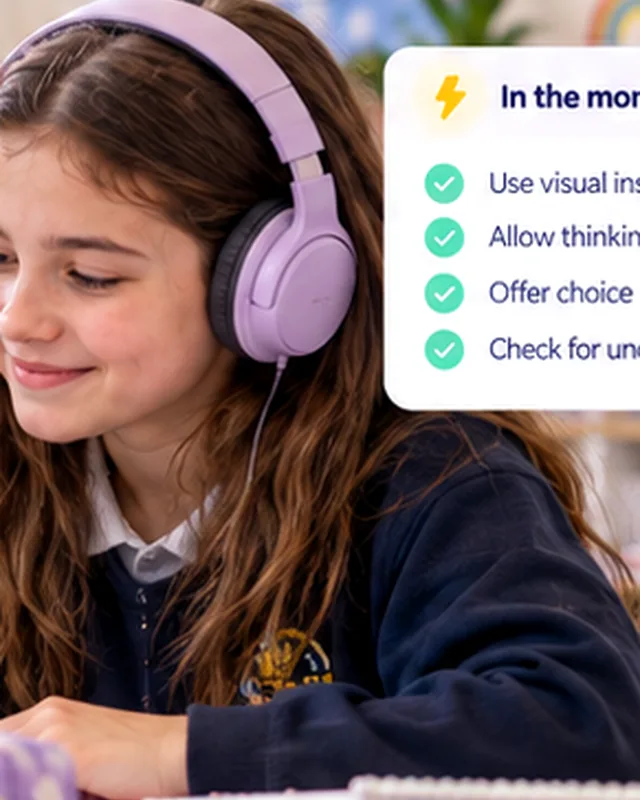
Mia understands scientific patterns but finds unstructured verbal instructions and noisy transitions difficult to navigate.

The evidence

The teacher documents strengths, access preferences, task conditions and what Mia demonstrates in different response formats.

Teacher response

With Mia’s input, Ms Carolina offers a visual sequence, a calmer work area, flexible explanation formats and an extended investigation.

Next evidence

Review conceptual reasoning, participation and increasing independence without removing useful access accommodations.